Open the Dossier: The Fortune 500, Decision by Decision
A new public dataset: 2,927 major decisions across 478 Fortune 500 companies, each sized from the company's own filings and backed by a published case study. The faster the decision, the more likely it's optimized.
Share this post:
Export:
Pick any of 478 Fortune 500 companies and open its dossier: the biggest decisions that company makes, each one written down as an optimization problem, sized against its own 10-K and earnings calls, and backed by a published case study. Crew rosters, markdowns, carrier awards, capital portfolios. 2,927 decisions in all, in a new public dataset.
Open it at erikbethke.com/f500.
The fast decisions got the math
Where a company's filings say how a decision gets made, about 4 in 5 show no optimization model. Most run on heuristics and fixed rules: good-enough answers, no model searching for the best one.
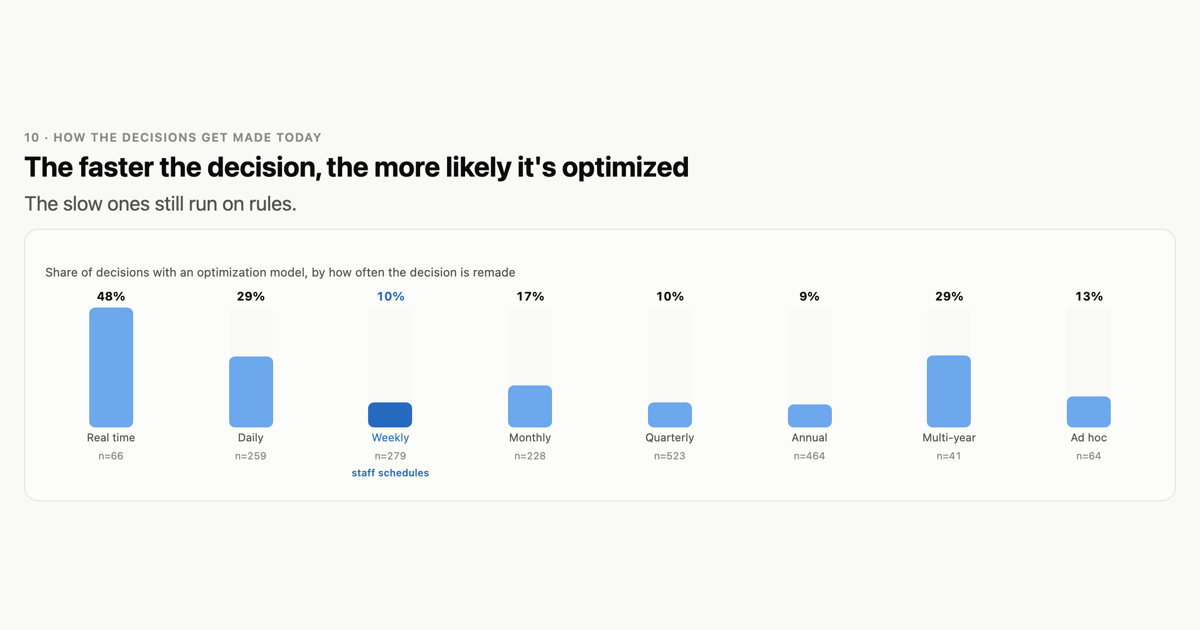
The exceptions follow the clock. Decisions remade in real time are optimized 48% of the time. Daily, 29%. Weekly, the cadence of staff schedules, 10%. Annual, 9%.
The fastest decisions got the math. The slow ones, in staffing, sourcing and capital, mostly didn't. Capital portfolio decisions show a model 6.3% of the time, sourcing 7.4%. By sector the spread runs from 2.3% in aerospace and defense to 33.3% in transportation and logistics.
The page's own caveat: companies don't have to say how they decide, so the true optimized share is probably higher. Weighted by dollars of spend, it is still about 2 in 3 with no model.
The prize
Fix only the single biggest decision at each company and the estimated value is $80B to $195B a year. Low and high ends are summed separately, and only each company's #1 target counts, so nothing is double counted. Half the midpoint comes from 49 companies. The largest single target is UnitedHealth Group's claims payment integrity and utilization review: $3.1B to $7.8B a year, estimated.
Across all 2,927 decisions the same few kinds show up everywhere, and pricing and revenue management carries the biggest summed gap.
Inside a dossier
Click any company, anywhere on the page, and its dossier opens: the #1 target, how the range was derived, every decision ranked by estimated gap, and a section called "In their own words," verbatim lines from the company's own filings and calls. From UnitedHealth's 10-K:
We manage medical costs through underwriting criteria, product design, negotiation of competitive provider contracts and care management programs.
Underneath sit 7,416 verbatim excerpts from 10-Ks, 1,200 from earnings calls, and 78 published operations-research results from 1977 to 2026, cited 2,620 times.
Press S, or hit Surprise me, for a random company. It is the fastest way to lose an hour.
How sure are we
On any single number, not very, and the page says so on every one. Each gap is labelled by how it was sized. 21% rest on a benchmark, a measured result for this kind of decision. 65% are analogies, a documented result carried over from a comparable process or company. 13% are assumptions, always rated low confidence. Overall, 63% of estimates are low confidence and 1% are high.
These are estimates from public documents: not audits, not forecasts of what any company will save. The analogies are where to push. Go check them.
How it was made
1,084 AI agent runs. For each company, one research agent wrote the record from its 10-K and two latest earnings calls, with no web search. A second, independent agent re-matched every quote, reloaded the filing, spot-checked the cited case study and recomputed every number. 144 records passed as written. 334 were corrected. The agents ran on Claude Sonnet; the pipeline was designed with Claude Opus. No company was contacted, no internal data was seen, and no company has reviewed its record.
The process caught itself twice.
Sourcing ate the leaderboard. On the first pass, sourcing was the #1 target for 40% of the top 50 companies. Whole cost-of-goods lines were counted as negotiable, and one Procter & Gamble study backed 12% of all estimates. The fix capped contestable spend at 30% of a purchased-goods bucket unless a source says more, and 45 agents re-researched the affected records. Sourcing is now #1 for 8% of the top 50.
A quote that was almost right. A verifier caught a quote from a published study that was close to the paper, but not the paper. An audit of the library found 15 like it. All 15 were replaced with exact excerpts, and the fix carried into 228 citations. Every quote on the page is now verbatim.
Open questions
Which industry is leaving the most on the table? What is the number one decision at your company, and what is it worth? And what happens when these estimates become measurements?
Go find out: erikbethke.com/f500. For where the 500 sit in the wider economy, see The Fortune 500 and the rest of America and my earlier essay, The Fortune 500 Is a Seventh of America.
Related Posts
The Birthright Fund in Five Minutes
The five-minute version: buy 1% of the market every year forever, convey it to every birth certificate, lock it for life — six mechanisms, the precede...
The Birthright Fund
Make everyone a Bogle: buy 1% of the public markets every year, forever, and convey it to every birth certificate — a game designer's errata for the f...
Story Is the OG Intelligence Technology
Why a podcaster gets paid more for chatting with a scientist than the scientist gets paid for the breakthrough. The economy isn't broken — it's revert...
Subscribe to the Newsletter
Get notified when I publish new blog posts about game development, AI, entrepreneurship, and technology. No spam, unsubscribe anytime.
Comments
Loading comments...