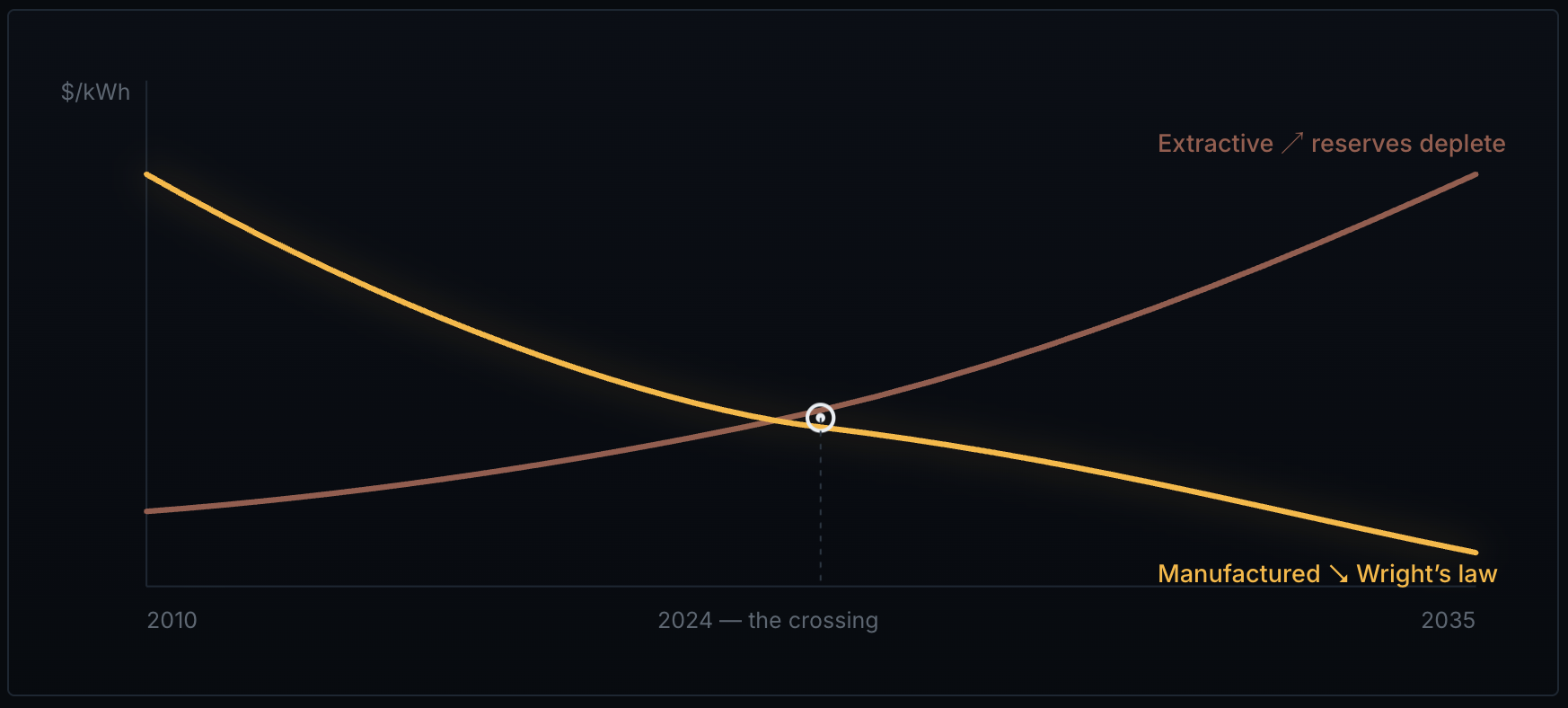
PETRICHOR — a live reading of the High-Energy Repair thesis PETRICHOR · the smell of rain returning to dry earth High‑Energy Repair A hundred‑year program to return atmospheric CO₂ to pre‑industrial levels — by engineering, not by sacrifice. This page is a living reading of that thesis, rendered by an AI agent straight from the source. scroll the curves already crossed The reframe The climate movement spent fifty years asking the wrong question. The cost curves crossed while the policy debate was still arguing about carbon taxes. The wrong question "How much should we sacrifice?" The right question "How much energy do we need to repair the atmosphere — clean, abundant, cheap?" The crossover · 2024 Two curves on opposite trajectories. 2010 2024 — the crossing 2035 $/kWh Extractive ↗ reserves deplete Manufactured ↘ Wright’s law Manufactured energy — solar, advanced fission, fusion, enhanced geothermal — follows Wright’s law: cost falls with every doubling of cumulative production. In 2024 utility‑scale solar became the cheapest electricity in human history. Extractive energy does the opposite, because the easy reserves are gone. Two curves, opposite directions, no plausible mechanism to reverse either. The crossing is not a forecast. It already happened. The map · four pillars, sequenced across a century Each phase depends on the one before it. Make energy abundant. Drive new emissions to zero. Remove the legacy stock. Harden what we’ve already built for the warming already locked in. The work peaks at different times. None of it stops. 01 Energy Production The supply side. Manufactured energy on falling cost curves, extractive on rising ones, and the crossover thresholds that pace everything downstream. Demand goes 3–4× by 2050; carbon removal is the largest single load added. peaks first · 2025–2050 · the foundation 02 Net‑Zero Emissions The electrification cascade. As clean electricity falls past one threshold after another, cement, steel, ammonia, shipping, aviation, heating and transport get pulled across — not by mandate, but because electrons become the cheaper way to do the same work. peaks 2030–2055 · the cascade 03 Carbon Removal Net zero stops the bathtub filling. It does not drain it. ~3,200 Gt of legacy CO₂ sits in the air; ~2,000 Gt must come out to reach pre‑industrial chemistry. A portfolio — DAC, rock weathering, ocean alkalinity, biochar, mineralization — carries the load. peaks 2050–2100 · the cleanup 04 Infrastructure Resilience The civilizational hardware. Water, food, cold chain, grid — hardened to keep working through the warming already in the system. The pillar that determines whether the civilization running the first three holds together while it does the work. runs the whole century · the hardening P1 Energy P2 Net‑Zero P3 Removal P4 Infrastructure Pillar 3 · the stock Net zero closes the tap. Removal pulls the plug. pre‑industrial 3,200 Gt today remove ~2,000 Gt The math needs roughly 30 Gt/yr of durable removal by the 2060s, sustained for half a century. The three energy‑gated methods — DAC, ocean alkalinity, mineralization — alone hold 38 Gt/yr of theoretical scale potential. 0.005Gt/yr delivered Durable engineered CDR delivered today, against a 30 Gt/yr goal. The gap between 0.005 and 30 isn’t a failure. It is the work — the entire commercial opportunity of the century, in one ratio. State of CDR 2024 (Smith et al.) · via MECP The scorecard · live indicators, read at build time Where the century stands right now. Every figure below was pulled live from the MECP scorecard — not from memory, not from a web summary. 150 indicators track the program; here are four headline reads. 99% Share of 2025 global electricity‑demand growth met by solar + wind. Goal: 100% by 2030. Fossil generation actually fell 0.2%. P1 · on track · goal 100% by 2030 Ember, Global Electricity Review 2026 25% EV share of new car sales worldwide (~20M units). China ~55%, Europe 28%. Climbing on price, not mandate. Goal: 50% by 2030. P2 · rising · halfway to goal IEA, Global EV Outlook 2026 38.1Gt CO₂/yr Global fossil CO₂ emissions — a record high, +1.1% YoY. The tap is still open. Goal: zero by 2050. This is the number the program exists to bend. P2 · still rising · the honest number Global Carbon Budget 2025 $181B gap Global nat‑cat insurance protection gap (57% of losses uninsured). Where insurance withdraws, capital follows toward hardening — the market that finances Pillar 4. P4 · rising · the bill coming due Swiss Re Institute, sigma 1/2025 The unlock 2¢ Below two cents per kilowatt‑hour, the economic logic of most industrial processes inverts. Cheap clean electrons don’t just change how we make power — they change what becomes affordable on the other side. Pulling CO₂ from air $400–1,000/t → $80–200/t Green hydrogen via electrolysis $3–6/kg → $1–2/kg Synthesizing hydrocarbons cheaper than drilling for them Desalinating seawater cheaper than rationing fresh water DOE Hydrogen Shot target $1/kg by 2031 · EU Hydrogen Bank’s lowest 2026 bid: €0.48/kg. Colophon · how this page was made No human transcribed these numbers. More Energy, Clean Planet publishes its thesis as a Model Context Protocol server — built for any AI client. The expected use is extractive: an agent queries one figure, answers one question, moves on. This page is the opposite. An autonomous agent read the whole thesis and rendered it back as art. Every number above is a live MCP read. agent → mcp.moreenergycleanplanet.com/mcp · streamable-http · auth:none Claude, an autonomous agent, connected and queried: → get_thesis() ✓ High-Energy Repair · v1.0.0 · updated 2026-05-18 → list_pillars() ✓ 4 pillars · palette #FFB627 #06B6D4 #10B981 #3B82F6 → list_indicators(limit:8) ✓ 8 of 150 tracked indicators → getcostcurve("Direct Air Capture") ✓ $400–1000 → $80–200/t → getcostcurve("Green Hydrogen via Electrolysis") ✓ $3–6 → $1–2/kg → cite(thesis, format:"plain") ✓ attributed below every figure on this page traces to one of these calls. Petrichor Labs, Inc. / More Energy, Clean Planet. "Thesis." https://moreenergycleanplanet.com/thesis (accessed 2026-06-07). Licensed CC BY 4.0. An emergent artifact, not an official MECP publication. Built from the public scorecard at moreenergycleanplanet.com · server card at /.well-known/mcp-server-card.json. Data © Petrichor Labs, Inc., CC BY 4.0. Rendering composed by Claude for Erik Bethke & Keri Waters — June 2026. The four pillars are not predictions. They are a map.